




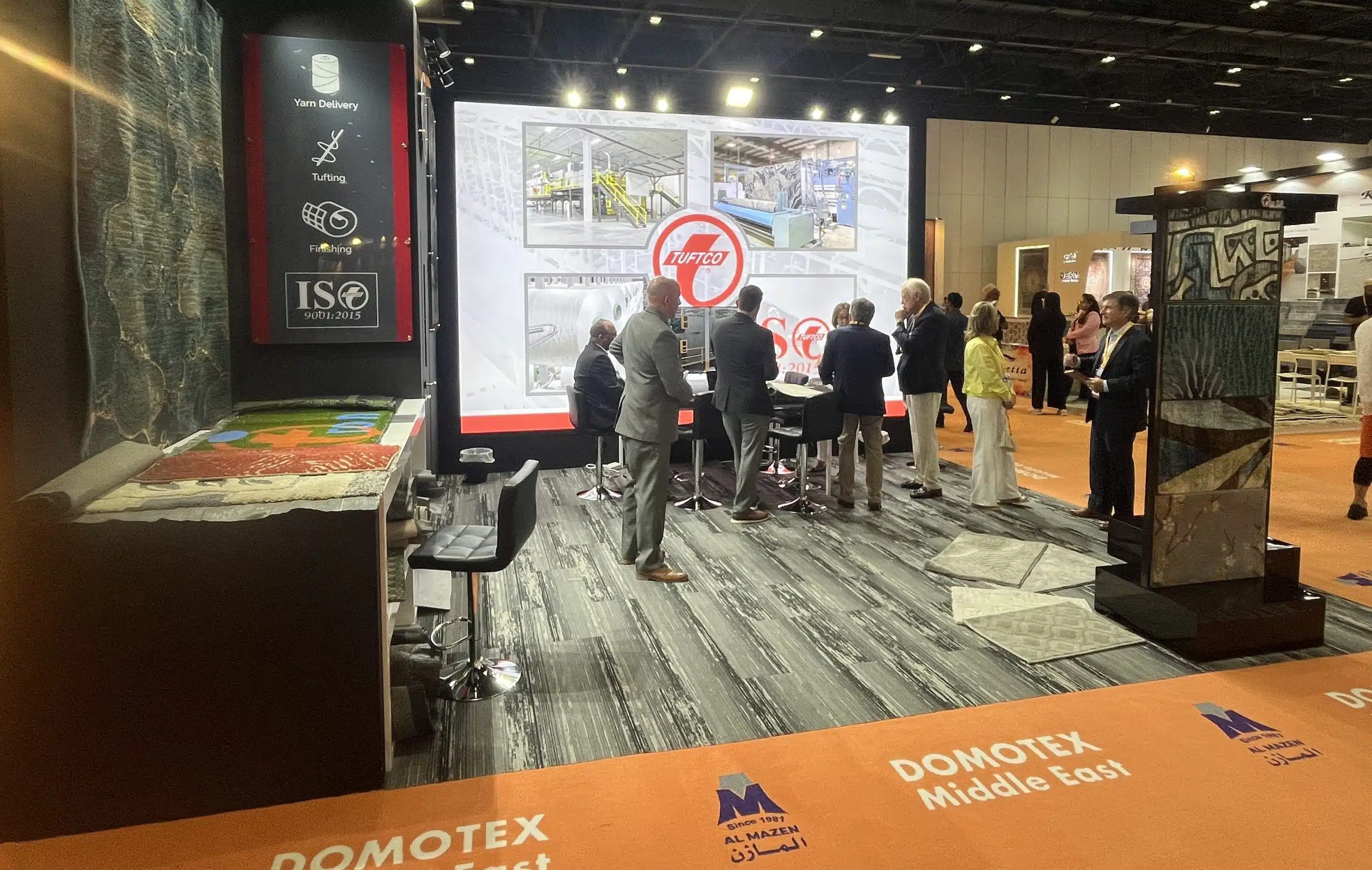
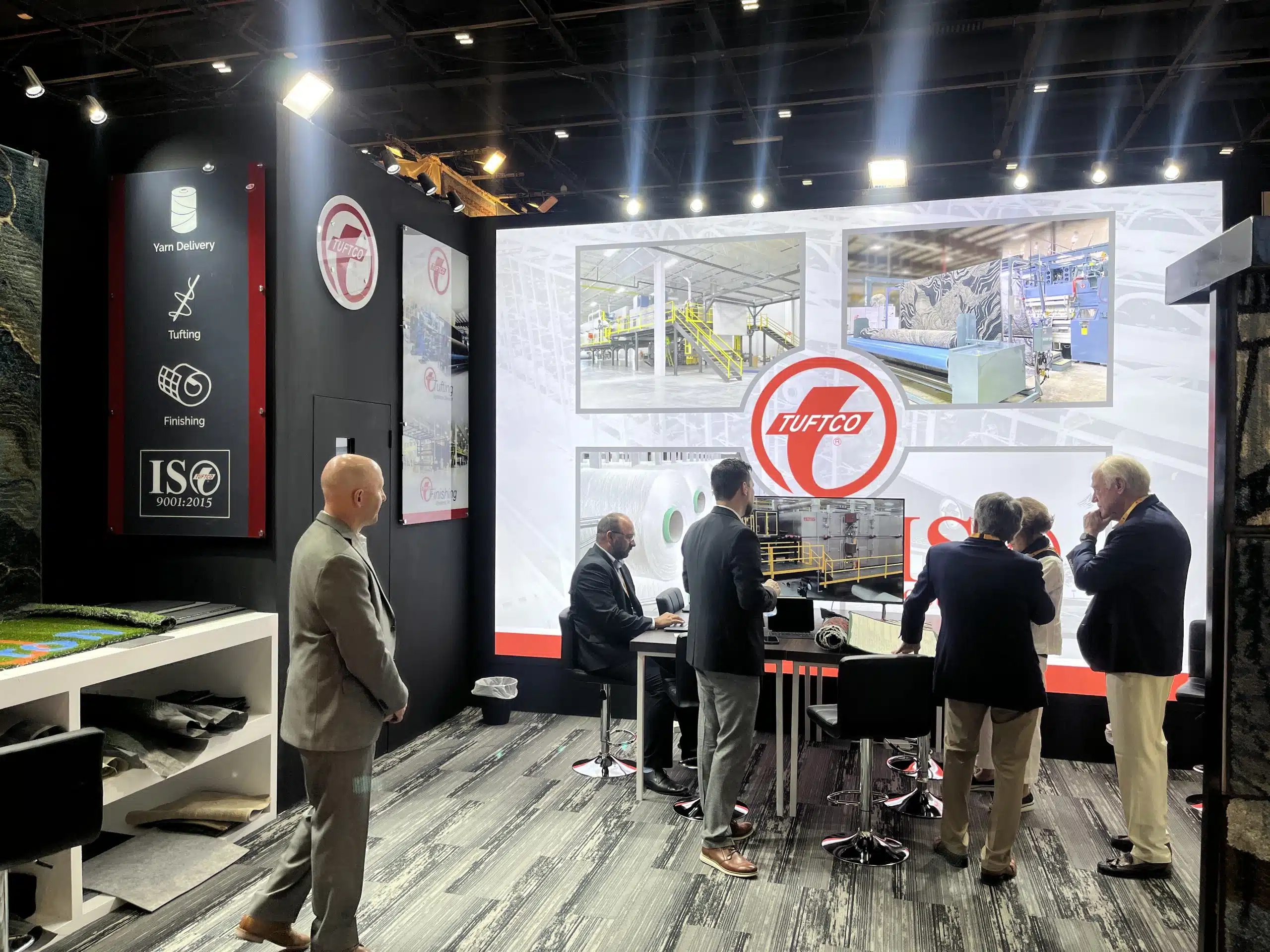
At Domotex, MENA Covering had the opportunity to sit down with Mr. Mark Harman, President at Tuftco Tufting Systems Division, to discuss the latest developments in the tufting machinery sector, the impact of global trade policies, and the future outlook of automation and sustainability in the carpet and flooring industries.
Tuftco’s Innovations: True3D and Itron Machines
Q: What new technologies is Tuftco introducing to the market?
A: This year, we are very excited about two major innovations:
True3D Technology: This is the most versatile tufting system in the industry. It allows manufacturers to create plain cut pile, loop and cut-loop (LCL) products, and even vary both the pile height and gauge within the same piece of carpet—all at the push of a button using our VTEC system. For instance, a designer can create a carpet that combines 1/8th gauge with a pile height of 8mm and, in the same carpet, a 1/12th gauge area with a pile height of 10mm. This offers unparalleled design flexibility and reduces the need for labor-intensive hand carving.
Itron Machine: A hollow-needle tufting machine that allows the direct tufting of logos, hash marks, and custom patterns onto artificial turf. Traditionally, sports turf logos were cut and stitched separately, but with the Itron, these can be tufted directly, eliminating weak points and improving field durability.
True3D Technology and Itron Machine both are helping to redefine efficiency, design freedom, and manufacturing precision.
The Impact of U.S. Tariffs on the Flooring Industry
Q: Recently, tariffs imposed by the U.S. government, particularly during President Trump’s administration, have had widespread effects. How has this impacted the flooring and carpet industries, and Tuftco specifically?
A: The tariff situation has indeed affected our business. Several of our customers, who had planned to purchase tufting and finishing equipment, postponed their decisions because of the uncertainty. As the tariff situation remains fluid and keeps evolving, many companies are taking a wait-and-see approach. This uncertainty has negatively impacted some of our international business.
Q: Do you see this trend continuing, or will it stabilize?
A: Eventually, businesses will adjust. People will get used to the “new normal,” and once the situation stabilizes, the flow of orders will resume. Markets always find a way to adapt over time.
Middle East Carpet Market Opportunities
Q: How do you see the Middle East market, particularly the UAE?
A: We have very good customers here in the UAE, and the market remains strong. There are a lot of ongoing projects, and our customers continue to invest in new machinery. We are optimistic about our continued growth in this region.
Q: How would you compare this year’s Domotex show to previous years?
A: The exhibition seems slightly smaller compared to last year in terms of the number of exhibitors. However, the visitor traffic has been steady. Yesterday started slow but picked up nicely towards the afternoon, and today is following a similar pattern. Overall, we are satisfied with the level of interest.
The Rise of Chinese Machinery and the Future of American Manufacturing
Q: With Chinese manufacturers improving quality and offering cheaper machinery, how do you view the competition?
A: Chinese machinery is definitely cheaper, but the quality, longevity, and service cannot match what American manufacturers provide. Our machines are built to last decades; we have machines from 1962 still in operation today. When you consider long-term value, maintenance, and production consistency, American machines are still a better investment.
Q: How do you see the future of U.S. carpet machinery manufacturing?
A: It’s definitely not as booming as it was during the 1970s-1990s when residential carpeting dominated. Hard surfaces have taken a share, especially in the residential sector. However, the commercial and hospitality sectors still heavily rely on carpets, and that’s where we focus. High-end residential projects also create demand for innovative, premium products like those made with True3D technology.
Innovation Beyond Speed: Automation and Smart Systems
Q: Some experts believe we have reached the physical limits of machine speed and performance. Where do you see the next wave of innovation?
A: The next frontier is not just speed but efficiency and predictive maintenance. For example, our TruSense device monitors yarn tension. If tension becomes unstable, it warns the operator before a yarn break happens, thus preventing downtime. Maximizing machine uptime is far more valuable than simply increasing speed.
Q: Could automation bring manufacturing back to the U.S. or Europe?
A: Absolutely. Some manufacturers are already integrating automated yarn creeling and loading systems, reducing the need for human operators. We used to require two or three operators per machine. Now with automation, you can have one person manage two or even three machines. Automation could make reshoring production more feasible in the future, especially as labor costs and shortages continue to rise in the U.S.
Q: What about countries like Turkey, India, or Bangladesh, where the textile industry depends heavily on labor?
A: That’s a very complex issue. In the U.S., government policies push for automation through rising minimum wages and additional employment costs. In labor-heavy economies, there might be more resistance, but eventually, global competition will drive adoption of automation even there. How they balance economic growth with potential job losses will be key.
The Future of Recycling in the Carpet Industry
Q: Sustainability and recycling are becoming increasingly important. How do you view the industry’s progress?
A: The carpet industry in the U.S. has been one of the leaders in recycling initiatives. Efforts have been ongoing for 20 years. One of the main innovations is the move towards mono-material carpets, where all components—fiber, primary backing, and secondary backing—are made from the same polymer, like polyester. This simplification makes recycling much more efficient because separating different materials is costly and difficult.
Big companies like Shaw, Mohawk, and Engineered Floors are leading the way, not only recycling carpets but also using materials like recycled PET bottles for yarn production.
Q: Do you see potential for new players in the carpet recycling sector?
A: Yes, definitely. There’s room for growth, especially as regulatory pressures increase and consumers demand more sustainable products. Major mills have invested heavily, but there is still a large untapped potential for innovation in recycling technologies and processes.
Closing Remarks
Mr. Mark Harman’s detailed insights reflect Tuftco’s deep commitment to innovation, quality, efficiency, and sustainability. In a rapidly changing global landscape—challenged by trade disputes, technological disruption, and environmental concerns—Tuftco continues to stand as a pioneer in advancing tufting machinery to meet the evolving needs of the carpet and flooring industries worldwide.

