




An Editorial by MENA Covering
Introduction: The Rise of a Carpet Manufacturing Powerhouse
Over the past three decades, the city of Gaziantep has transformed itself into one of the most influential centers of machine-made carpet manufacturing in the world. Once known primarily as a regional trading and weaving city in southeastern Türkiye, Gaziantep has evolved into a globally recognized industrial cluster that exports carpets to more than 190 countries and shapes trends across international flooring markets.
Today, when global buyers search for machine-made carpets, yarn technologies, woven rugs, or advanced carpet production systems, the name Gaziantep inevitably appears at the center of the conversation.
But this transformation did not happen overnight.
Behind the massive export figures, advanced weaving technologies, and growing international presence lies a complex story of industrial strategy, entrepreneurship, design adaptation, technology investment, and manufacturing culture. More importantly, Gaziantep’s success offers valuable lessons for other carpet-producing regions across the Middle East and Asia.
From Traditional Weaving to Industrial Carpet Production
The roots of Gaziantep’s carpet culture go back centuries. Historically, the region was known for traditional weaving and textile craftsmanship, benefiting from its strategic position between Anatolia, the Middle East, and ancient trade routes.
However, the real industrial transformation began during the late twentieth century, when Turkish manufacturers started investing heavily in machine-made carpet technologies. Instead of remaining dependent on traditional production methods, companies in Gaziantep embraced industrialization aggressively.
The introduction of modern weaving systems, particularly technologies supplied by European manufacturers such as Van De Wiele, allowed local producers to dramatically increase production capacity while maintaining competitive pricing.
This technological transition fundamentally changed the scale of the industry.
What was once a regional manufacturing activity gradually became a globally integrated export sector capable of serving markets in Europe, the Middle East, Africa, and North America.
The Power of Industrial Clustering
One of the key reasons behind Gaziantep’s success is the development of a highly concentrated industrial ecosystem.
Unlike fragmented manufacturing structures seen in many countries, Gaziantep developed a powerful production cluster where spinning mills, yarn suppliers, dyeing units, weaving factories, machinery distributors, packaging companies, logistics providers, and design studios all operate within close proximity.
This concentration created enormous operational advantages.
Manufacturers could source yarns faster, solve technical issues more efficiently, reduce logistics costs, and adapt rapidly to market demands. The city gradually became a self-sustaining industrial network capable of handling every stage of carpet manufacturing.
This ecosystem also encouraged intense competition between producers, which pushed companies toward continuous investment and innovation.
Technology as the Core Driver of Growth
Technology investment has played a decisive role in Gaziantep’s rise.
Turkish carpet manufacturers understood early that competing globally would require more than cheap labor or low production costs. The industry invested heavily in modern weaving systems, automation technologies, yarn processing equipment, and digital design infrastructure.
Advanced machine technologies enabled manufacturers to produce:
- higher-density carpets
- more complex textures
- improved color precision
- faster production cycles
- larger production volumes
At the same time, automation reduced production errors and increased consistency, which became critical for export markets.
The adoption of polypropylene, polyester, and acrylic yarn systems also helped manufacturers diversify their product ranges for different global markets and price segments.
Today, Gaziantep’s factories are among the most technologically advanced carpet production facilities in the region.
Also Read: Gaziantep at the Heart of Global Carpet Design
The Often-Ignored Role of Carpet Designers
While machinery and production capacity receive most of the attention, another factor has been equally important in Gaziantep’s growth: design.
Machine-made carpets are no longer purely industrial products. They are increasingly influenced by fashion, interior design trends, color psychology, lifestyle preferences, and regional aesthetics.
As competition intensified, manufacturers realized that production power alone was not enough. Design became one of the most important differentiators in the market.
Professional designers began using specialized software systems such as Texcelle and Photoshop to create collections tailored to specific export destinations.
European markets demanded minimalist and neutral styles.
Middle Eastern markets preferred luxury-inspired classical patterns.
African buyers often favored bold colors and geometric structures.
This ability to adapt designs quickly to changing international preferences became one of Gaziantep’s biggest strengths.

Export Markets and Global Expansion
Gaziantep’s success is deeply connected to exports.
Türkiye’s strategic geographic location provides direct access to Europe, North Africa, the Gulf region, and Central Asia. This positioning allowed Turkish manufacturers to deliver products faster than many Asian competitors.
Over time, Turkish carpet companies expanded aggressively into international markets through:
- trade fairs
- distributor networks
- private label manufacturing
- international partnerships
- digital marketing channels
The city gradually became one of the largest machine-made carpet export centers in the world.
At the same time, manufacturers learned how to produce for multiple price levels simultaneously—from mass-market retail products to premium collections.
This flexibility helped Gaziantep survive economic crises, currency fluctuations, and changing global demand patterns better than many competitors.
Challenges Behind the Success Story
Despite its achievements, Gaziantep’s carpet industry also faces serious challenges.
One of the biggest issues is increasing global competition, particularly from Asian producers offering lower-cost alternatives.
Another challenge is design imitation. Many designers working in the industry complain about rapid copying of successful collections, reducing incentives for original creativity.
Raw material costs also continue to create pressure. Acrylic fiber prices, energy expenses, and logistics costs have increased significantly in recent years.
In addition, global uncertainty, inflation, geopolitical tensions, and slowing construction markets in some regions are affecting international demand for flooring products.
Sustainability is becoming another critical issue.
International buyers increasingly expect recyclable materials, environmentally responsible production, and transparency throughout supply chains. Manufacturers that fail to adapt to these expectations may struggle in future export markets.
Digital Printing and the Next Evolution
The future of Gaziantep’s carpet industry may be shaped by digital technologies.
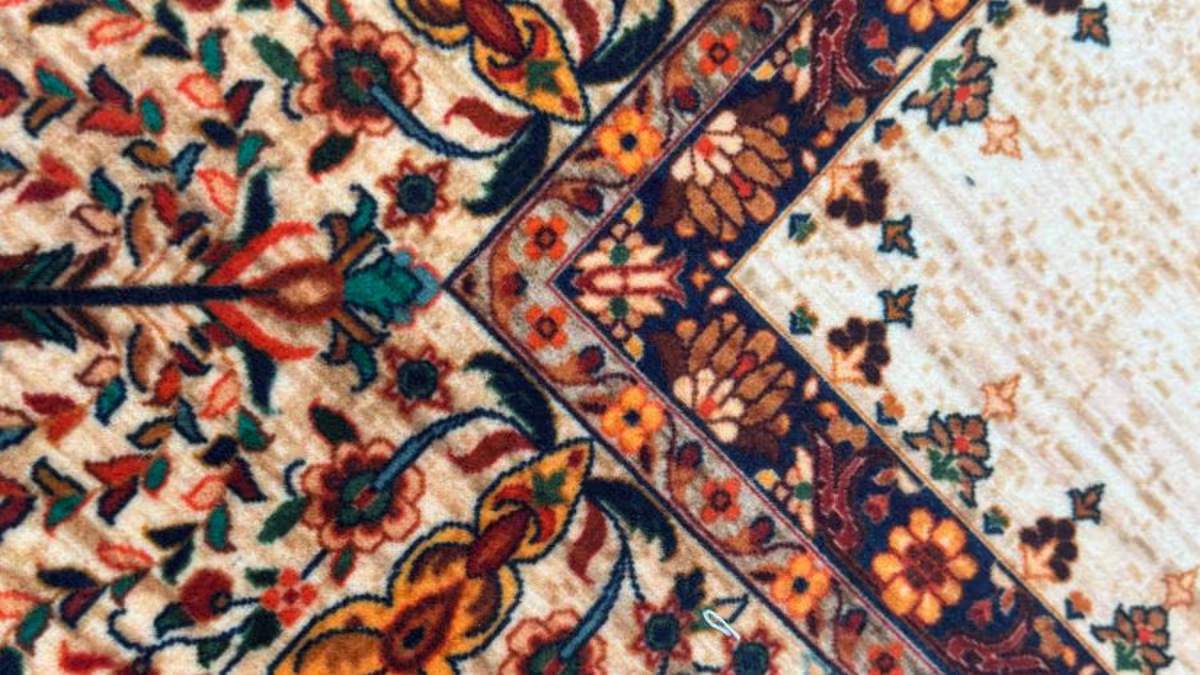
Digital carpet printing systems are opening entirely new possibilities in:
- customization
- short-run production
- color flexibility
- faster collection development
This transition could fundamentally reshape the industry over the next decade.
Companies investing early in digital carpet technologies may gain major competitive advantages, particularly as global consumers demand more personalized and trend-driven products.
A Model for the Wider Region
Gaziantep’s story is not only important for Türkiye.
For many countries across the Middle East, North Africa, and Central Asia, the city represents a model of how industrial specialization, export orientation, and manufacturing ecosystems can transform a regional industry into a global player.
The success of Gaziantep demonstrates that long-term investment in technology, design, and industrial infrastructure can create internationally competitive industries even in highly challenging global markets.
Conclusion
Gaziantep’s transformation into a global carpet manufacturing powerhouse is the result of decades of investment, industrial discipline, export strategy, and technological adaptation.
What makes the city unique is not only its production volume, but its ability to combine manufacturing scale with flexibility, speed, and market responsiveness.
As the global flooring industry continues to evolve, Gaziantep appears well positioned to remain one of the world’s most influential machine-made carpet hubs—provided it continues investing in innovation, sustainability, and design-driven manufacturing.
Editor’s Comment – Behnam Ghasemi, Editor-in-Chief of MENA Covering
“Gaziantep is no longer simply a production city; it has become one of the strategic centers shaping the future of the global machine-made carpet industry. What makes this ecosystem remarkable is the combination of technology, entrepreneurship, speed, and adaptability to international markets. In our view at MENA Covering, the next phase of competition in the carpet industry will not be defined only by production capacity, but by innovation, design intelligence, and the ability to respond rapidly to changing global consumer trends. Gaziantep has understood this transformation earlier than many others.”

