




Strong residential demand, commercial renovation projects, and sustainability innovations are driving growth across the global tufted carpet industry.
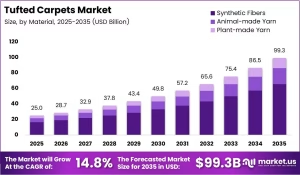
The global tufted carpet market is poised for significant expansion over the next decade, with industry forecasts projecting market value to increase from $25 billion in 2025 to approximately $99.3 billion by 2035, representing a compound annual growth rate (CAGR) of 14.8%.
Tufted carpets remain the dominant flooring category worldwide due to their cost efficiency, durability, design flexibility, and ability to meet both residential and commercial requirements. The manufacturing process, which involves inserting yarn loops into a primary backing and securing them with adhesives and a secondary backing layer, allows producers to achieve consistent quality at large production volumes.
Residential Sector Remains the Main Growth Engine
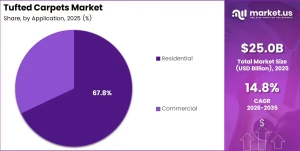
Residential applications continue to account for the largest share of demand, representing 67.8% of the global market in 2025. New housing developments, apartment construction, and home renovation projects are driving steady demand for tufted carpets, particularly in bedrooms, living rooms, and hallways where comfort, thermal insulation, and noise reduction are key considerations.
As homeowners increasingly view flooring as an essential element of interior design rather than simply a functional surface, manufacturers are responding with more sophisticated textures, colors, and custom design options.
Commercial Markets Create Long-Term Demand
Commercial sectors such as hospitality, healthcare, corporate offices, airports, and retail facilities continue to provide a strong secondary demand base.Hotels and office buildings regularly replace carpets during renovation cycles, creating recurring demand regardless of fluctuations in new construction activity. The hospitality industry, in particular, values tufted carpets for their ability to combine durability, acoustic performance, and visual appeal at competitive costs.
Manufacturers are also introducing new technologies to address evolving customer requirements. In 2025, Shaw Floors expanded its Pet Perfect+ collection with new tufted carpet designs featuring spill-proof backing systems aimed at improving durability and maintenance performance.
Synthetic Fibers Dominate Production
By material type, synthetic fibers continue to dominate the market, accounting for 65.3% of total consumption. Nylon, polyester, and polypropylene remain the preferred materials due to their stain resistance, resilience, color retention, and cost advantages.
However, demand for sustainable and recycled materials is growing rapidly. Manufacturers are increasingly investing in recycled nylon technologies and environmentally friendly production methods to align with green building requirements and corporate sustainability goals.
Sustainability Becomes a Strategic Priority
Environmental concerns are reshaping the tufted carpet industry. According to industry data, the United States discards approximately 3.5 billion pounds of carpet annually, while only around 5% is recycled, highlighting the need for stronger recycling infrastructure and circular economy solutions.
At the same time, progress is being made. The California Carpet Stewardship Program reported a 43.1% carpet recycling rate in the first quarter of 2025, demonstrating that coordinated recycling initiatives can significantly improve sustainability outcomes.
Leading manufacturers are increasingly focusing on recycled-content carpets, closed-loop production systems, and end-of-life recovery programs to differentiate themselves in a competitive market.
Read more : All Types of Carpets: A Complete Guide to Carpet Styles, Uses, and Materials
Asia-Pacific Emerges as Fastest-Growing Region
While North America currently leads the market with a 34.6% share valued at $8.4 billion, Asia-Pacific is expected to be the fastest-growing region over the forecast period. Urbanization, rising household incomes, expanding hospitality infrastructure, and growing domestic consumption are driving demand across China, India, and Southeast Asia.
Recent investments reflect this optimism. Mohawk Industries announced a $45 million investment in India to establish new tufted carpet manufacturing capacity, signaling confidence in the region’s long-term growth prospects.
Innovation Driving the Industry Forward
Digital printing, antimicrobial treatments, stain-resistant technologies, and modular carpet tile systems are among the innovations transforming the sector.Manufacturers are increasingly shifting their focus from volume-driven growth to value-added products that offer enhanced design flexibility, customization, and sustainability credentials. As commercial and residential customers seek higher-performance flooring solutions, innovation is becoming a key competitive differentiator.
With demand rising across both mature and emerging markets, the tufted carpet industry is entering a new phase of growth characterized by technological advancement, sustainability investments, and increasing emphasis on premium product offerings.

