




As the global flooring industry prepares for DOMOTEX asia/CHINAFLOOR 2026, questions surrounding quality control, compliance, sourcing risks, and supply chain transformation are becoming increasingly important for manufacturers, importers, and distributors worldwide.
In this exclusive interview conducted by Behnam Ghasemi, Editor-in-Chief of MENA Covering, Mr Farnam Sharifi Founder & CEO of IFL share valuable insights into the evolving dynamics of flooring production across China and Southeast Asia, the growing role of third-party inspection, and the major trends reshaping international flooring trade.
The discussion also highlights why quality assurance, compliance verification, and long-term supplier relationships are becoming strategic priorities for companies operating in fast-growing markets such as the Middle East and Africa.

Read more : DOMOTEX asia/CHINAFLOOR 2026: Complete Visitor Guide
Q1. How do you see the evolving role of quality control and compliance in today’s global flooring industry?
These are two distinct pillars of our industry operating on fundamentally different dynamics, and both are growing in strategic importance. Quality Control is ultimately a choice, and that choice reveals a great deal about a business. Importers who embed quality into their brand DNA build stronger, more resilient companies with lasting customer loyalty. With nearly three decades of flooring production experience, China and Southeast Asia have developed genuinely world-class manufacturing capability.
In today’s environment of instant global market access and increasingly informed consumers, quality has become a true competitive differentiator. Leading manufacturers are investing in in-house laboratories, tightening raw material specifications, and leveraging AI-assisted inspection tools to raise consistency and reduce human error.
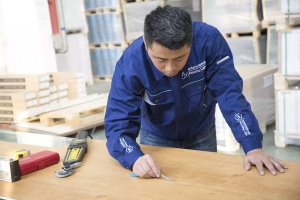
Additionally, the involvement of a third-party QC company, like IFL, is also becoming increasingly common as it adds value at every stage of the business cycle – from defining product specifications and tolerances at the start, to inspecting raw materials, and conducting mid-production checks, through to pre-shipment inspection and testing, which serves as the final line of defense against any defects that may have slipped through earlier in the process. Quality can no longer simply be promised, it has to be proven, and increasingly, documented.
Compliance, by contrast, is non-negotiable – a top-down mandate shaped by environmental regulation, human health standards, and geopolitical realities. For the MENA region, the tightening of mandatory conformity certification requirements under SASO and broader GCC standards bodies illustrates precisely how swiftly regulatory shifts can redefine market access; suppliers who fall short face product holds, port rejections, and loss of business in one of the world’s most dynamic construction markets.
ESG (Environmental, Social, and Governance) expectations are adding further pressure: formaldehyde emissions standards, recycled content claims, and supply chain transparency are moving from voluntary commitments to enforceable requirements. Digitization has fundamentally shifted enforcement, data transparency means “best effort” compliance is no longer acceptable, and the consequences of falling short – market bans, product recalls, reputational damage, and legal liability – are all very real. Chain-of-custody document review, multilingual due diligence, and regulatory compliance verification are not administrative formalities; they are essential safeguards protecting clients’ brands, market access, and long-term integrity.
Q2. What are the most common challenges buyers face when sourcing flooring products from Asia?
With several thousand flooring factories across Asia, the first challenge is simply knowing where to begin; developing a robust vetting and supplier selection process that goes beyond price comparison to assess production capability, quality systems, and long-term reliability. Once a supplier is selected, the focus shifts to ensuring every shipment consistently meets contracted specifications, standards, and tolerances.
Achieving batch-to-batch consistency, maintaining colour, texture, grade, and dimensional stability across multiple shipments and multiple years, is one of the most persistently underestimated challenges in flooring procurement, and one that costs buyers dearly when it breaks down. Currency fluctuations, lead time reliability, and communication barriers across time zones and languages add further layers of complexity that experienced buyers learn to manage but that can be genuinely disruptive for those newer to Asian sourcing.
The other significant challenge is handling complaints and claims effectively. When a quality issue arises at destination, determining whether it is a manufacturing defect, and if so, quantifying it and structuring an appropriate resolution, can become protracted and costly without prior documentation. This is where a pre-shipment, third-party QC report becomes invaluable: it establishes an independent, professional record of the goods’ condition prior to shipment, dramatically strengthening both parties’ positions and reducing the risk of costly disputes. At IFL, both our onsite inspections and laboratory testing are ISO certified, meaning our reports carry legal standing in courts worldwide. This provides a level of protection that has proven decisive for many of our clients in resolving cross-border trade disputes swiftly and fairly.

Read more : DOMOTEX asia/CHINAFLOOR 2026: Must-attend Design Events
Q3. How does third-party inspection help reduce risks in international trade?
The act of introducing third-party inspection into a supply chain does something that is often underappreciated: it immediately elevates quality assurance to a strategic priority. Suddenly, QC standards, product specifications, tolerances, and compliance requirements must be clearly defined and contractually agreed upon between buyer and supplier, before production even begins. This discipline alone drives significant improvement, as it forces both sellers and buyers to articulate expectations precisely, building quality into purchase contracts and production schedules rather than hoping for it at the end.
Systematic pre-shipment inspections, and testing, enables defects to be detected and corrected before goods leave the factory, reducing costly shipping delays, rejected containers, and the cash flow strain that falls on both buyer and seller when shipments go wrong. The financial and operational value of consistently defect-free, on-time shipments is substantial and frequently undervalued until something goes wrong.
But the benefits extend well beyond risk mitigation. When third-party QC is embedded consistently into a trading relationship, the knock-on effects are transformative: factories perform better knowing their output will be independently verified; buyers gain confidence to grow their orders; and the overall commercial relationship strengthens on a foundation of trust and accountability.
At IFL, we frequently observe that our involvement is welcomed by factories themselves, who recognise that our independent assessments protect their reputation as much as our clients’. The intangible returns of stronger brands, more loyal partnerships, sustained growth, and improved profitability, ultimately far outweigh the cost of the service. In international trade, third-party inspection is not an added expense; it is a form of commercial insurance with a measurable return.

Q4. What key trends are currently shaping the global flooring supply chain?
Geopolitics, tariff realignments, raw material supply pressures, tightening compliance regimes, and accelerating demand for innovation are collectively reshaping the global flooring supply chain at a pace we have rarely seen before. The most visible manifestation is a polarisation of trade flows: US buyers have pivoted heavily toward Southeast Asian sourcing in response to tariff pressures, while European importers of engineered wood flooring have similarly redirected purchasing following the anti-dumping duties that came into effect in 2025. The net effect for the rest of the world – including MENA markets – is an expanded and increasingly competitive supplier landscape, with factories actively seeking to diversify their customer base and reduce dependence on any single large market. For MENA importers, this represents a genuine opportunity to negotiate stronger terms, access broader product ranges, and build more strategic supplier relationships than were previously available to them.
For the factories themselves, navigating this new landscape is a delicate balancing act. Concentrating too heavily on a single dominant market risks overextending supply capacity, straining production staff, and compromising quality under volume pressure, while insufficient orders create cash flow stress, talent retention challenges, and weakened raw material purchasing power. What gives me confidence in the long-term resilience of this industry is the remarkable adaptability of Chinese and Southeast Asian manufacturers – their ability to innovate, reinvent production lines, and pivot to new markets is genuinely impressive.
Sustainability and material innovation, including next-generation waterproof cores, bio-based finishes, and responsibly sourced timber, are also gaining traction as differentiators, driven by both consumer demand and tightening environmental compliance. The flooring supply chain is under pressure, but it is also evolving into something more sophisticated, more transparent, and ultimately more robust.

Q5. How do you see the role of China and Southeast Asia evolving in flooring production?
Since around 2016, the migration of flooring manufacturing from China into Southeast Asia, principally Vietnam, Malaysia, Indonesia and more recently Thailand, has accelerated significantly, driven initially by tariff pressures and subsequently reinforced by rising Chinese labour costs and evolving trade policies.
What is particularly noteworthy about this shift is its quality trajectory: the factories being established in Southeast Asia are frequently larger, better equipped, and built around newer machinery and technology than their Chinese predecessors – while ownership and senior management often carry the same near three-decade depth of flooring expertise. The result is a Southeast Asian manufacturing base that has matured rapidly and now produces products that are genuinely competitive on quality, not merely on price. Meanwhile, Chinese factories, facing reduced volumes in certain export markets, have responded by innovating, investing in automation, advanced surface technologies, and higher-specification product development to defend and grow their market positions.
The combined effect of these parallel evolutions is a stronger, more diversified, and more competitive Asia-Pacific production base than has ever existed. Emerging technologies, including precision digital printing, 3D textured surfaces, and AI-integrated quality monitoring, are being adopted across both regions, further elevating product sophistication. For global buyers, including those in MENA, this means access to an unprecedented breadth of product innovation, sourcing flexibility, and supplier choice. China and Southeast Asia are not ceding their position as the world’s flooring production heartland – they are reinforcing it, through a combination of accumulated expertise, competitive scale, and a capacity for reinvention that is genuinely unmatched anywhere in the world.
Q6. What advice would you give to importers and distributors in the Middle East and Africa?
My primary advice is this: never allow price to become the sole determining factor in your sourcing decisions. One of the guiding principles we display prominently at IFL is that “quality is remembered long after price is forgotten” – and we have seen this truth play out repeatedly across our 24 years of working with flooring buyers and suppliers worldwide. Factories in China and Southeast Asia are exceptionally resourceful and service-oriented; if a buyer pushes hard on price, they will genuinely try to accommodate, but never at a loss to themselves. Something will give, and that something is almost always quality.
Cross the threshold of acceptable quality and consistency, and you open the door to production shortcuts that ultimately harm your product, your customer relationships, and your brand reputation in the market. The most successful MENA importers we work with consciously design their products to hit their target price point without sacrificing the quality standards that underpin their long-term competitiveness.
My second piece of advice is to formalise your quality framework from the outset. Define your specifications, tolerances, and performance standards contractually, and then protect them through independent verification. Engage a third-party QC partner like IFL to help you and your supplier align on those standards, and then systematically verify them through pre-shipment inspections and laboratory testing before goods leave the factory. Think of it as commercial insurance: the cost is modest relative to the expense of a delayed shipment, a rejected container, or a wave of customer complaints at destination.
The MENA construction and real estate market is growing at extraordinary speed – the opportunity for flooring importers and distributors in this region is significant, and those who build quality into their supply chain from the ground up will be best positioned to capture it sustainably. As we say at IFL: “Quality is never an accident, it is always the result of intelligent effort.”

