




Carpets have long transcended their functional role as floor coverings to become cultural artefacts, symbols of identity, craftsmanship, and historical continuity. With a documented history stretching back over 2,500 years, carpet weaving—particularly in Iran—stands among the world’s most sophisticated and enduring art forms.
Recent auction records and museum collections reaffirm this status, as Iranian carpets dominate the list of the world’s most expensive rugs ever sold. These masterpieces, woven centuries ago, continue to command multi-million-dollar prices, underscoring not only their artistic value but also their significance within global cultural heritage.
Iranian Carpets Lead the Global Ranking
Among the eight most expensive carpets in history, Iranian works occupy the majority of top positions, followed by rare examples from India and France. The rankings include:
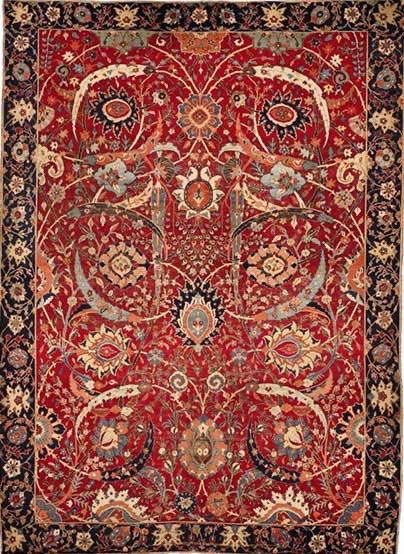
- The Clark “Sickle-Leaf” Carpet (Iran, 17th century) – sold for USD 33.8 million
- The Vase Carpet (Iran, mid-17th century) – USD 10 million
- The Kerman “Vase” Carpet (Iran, 17th century) – USD 9.6 million
- The Baroda Pearl Carpet (India, 19th century) – USD 5.5 million
- The Mughal Star Lattice Carpet (India, 18th century) – USD 7.7 million
- Isfahan Silk Rug (Iran, 17th century) – USD 4.45 million
- Louis XV Floral Medallion Carpet (France, 18th century) – USD 4.40 million
- Small Medallion Carpet (Iran, 16th century) – USD 2.4 million
This concentration of Iranian carpets at the top of the list is no coincidence. It reflects centuries of accumulated knowledge in design, dyeing, material selection, and knotting techniques that were passed down through generations of artisans.
Also Read: Iran’s Handwoven Carpet Market Faces Unequal Competition from Afghan and Machine-Made Rugs
The World’s Most Expensive Carpet: A Kerman Masterpiece
The Clark “Sickle-Leaf” Carpet, widely regarded as the most expensive carpet ever sold, was woven between 1600 and 1650 in Ravar, Kerman, one of Iran’s most renowned weaving centres. Measuring approximately 2 × 2.5 metres, the carpet features an asymmetrical Persian knot, cotton warp, wool pile, and a distinctive triple-weft structure incorporating silk.
Its design—marked by sickle-shaped leaves, Shah Abbasi floral motifs, and stylised cypress trees—exhibits deliberate asymmetry, a rare and sophisticated artistic choice that suggests the carpet may once have formed part of a larger ensemble.
Despite its age, the carpet’s colours remain remarkably vibrant, a testament to the mastery of natural dyeing techniques employed by Iranian artisans centuries ago.
Originally acquired around 1900 by American senator William A. Clark, the carpet later entered the Corcoran Gallery of Art in Washington, D.C. In 2013, it was auctioned and sold to an anonymous buyer for USD 33.8 million—far exceeding initial estimates and setting a new global record.
More Than Decoration: Carpets as Cultural Assets
Historically, such carpets were not merely household items but symbols of wealth, prestige, and power—often commissioned by royal courts or presented as diplomatic gifts. Today, they are recognised as movable cultural heritage, displayed in leading museums and sought after by collectors worldwide.
The continued dominance of Iranian carpets at the highest levels of the global art market highlights a deeper reality: Persian carpets are valued not only for their beauty, but for the cultural memory, craftsmanship, and identity they embody.
As global interest in authentic, heritage-driven design grows, these historic masterpieces serve as powerful reminders of Iran’s foundational role in shaping the world’s carpet and textile traditions—an influence that remains unmatched centuries later.

