




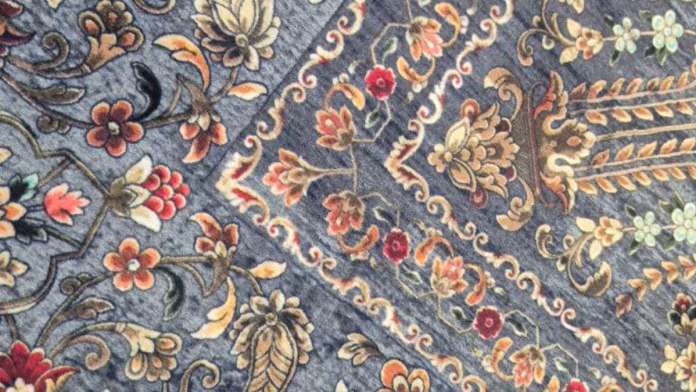
Before we consciously notice its pattern or construction, we feel it. The softness beneath our feet. The warmth it brings into a space. The subtle acoustic comfort it creates in a room filled with movement. A carpet does not simply sit on the floor — it transforms the environment.
Yet what most people experience as comfort is, in reality, the outcome of one of the most technically demanding segments of the textile industry.
Carpet manufacturing is not merely about weaving fibers together. It is about synchronizing design, engineering, chemistry, logistics, and quality control into one seamless system. And in today’s global market, few regions embody this intersection more powerfully than the Middle East.
From Cultural Heritage to Industrial Precision
The origins of carpets are deeply intertwined with human civilization. Across Persia, Anatolia, Central Asia, and the Indian subcontinent, carpets were once handcrafted narratives — expressions of identity, tradition, and craftsmanship passed down through generations.
Over time, these woven artifacts evolved from cultural treasures into global trade commodities. Industrialization reshaped the industry, introducing mechanical looms, advanced yarn technologies, and mass production systems. What once required months of manual knotting could now be engineered through highly sophisticated manufacturing lines.
But industrialization did not eliminate artistry. Instead, it elevated the importance of precision.
Modern carpet manufacturing demands exact control over fiber consistency, pattern alignment, dimensional stability, and dye uniformity. A carpet may look soft and simple, but behind it stands a complex production ecosystem where even minor deviations can compromise an entire project.
Also Read: Raw Material Volatility: The Weak Link in Polypropylene Carpet Manufacturing in Iran
The Technical Anatomy of a Carpet
Every carpet begins with a fundamental decision: fiber selection.
Whether wool for its natural resilience, polypropylene for cost-efficiency, nylon for durability in high-traffic environments, or polyester for enhanced color vibrancy, the raw material defines the carpet’s performance and positioning. The choice determines not only tactile comfort but also long-term wear behavior, stain resistance, and structural integrity.
Construction follows. Tufted carpets dominate global production due to efficiency and design flexibility, while woven constructions continue to serve premium segments. Needle-punched formats support technical and contract applications. Each method carries distinct implications for density, texture, and lifespan.
Yet perhaps the most underestimated stage is color management. Unlike fashion textiles, carpets are frequently produced in large-scale installations. A slight variation between dye lots becomes immediately visible across continuous surfaces. For manufacturers, color consistency is not a preference — it is an operational obligation.
In carpet manufacturing, softness is emotional. Precision is technical.
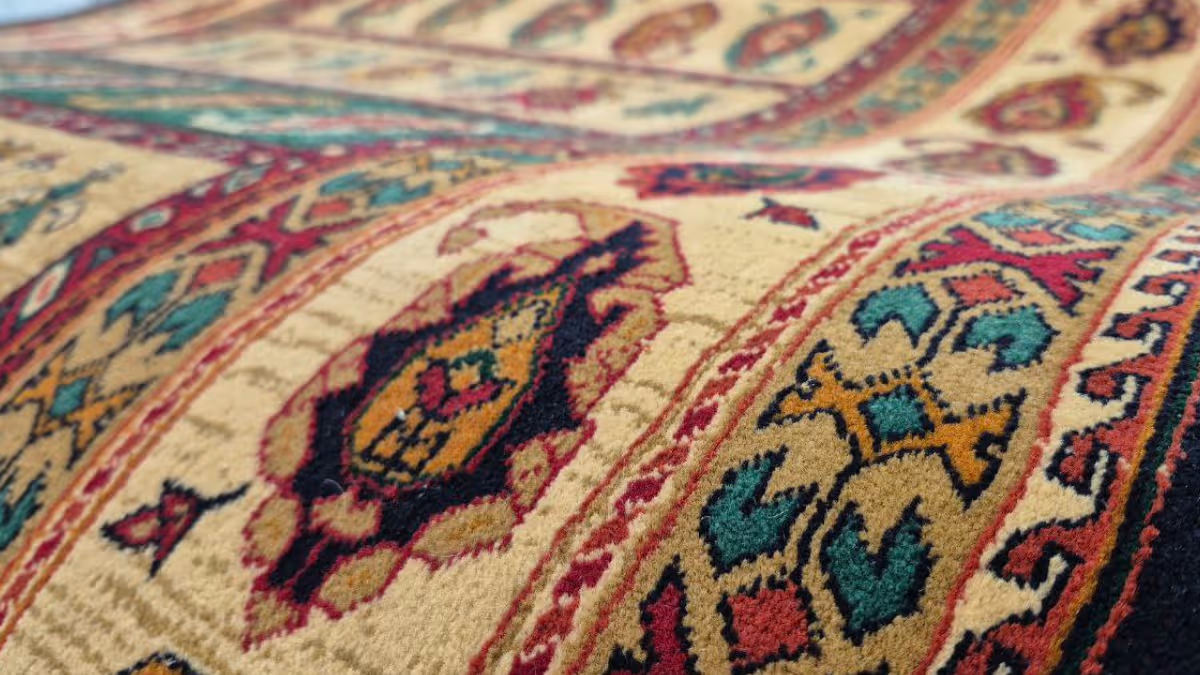
Why the Middle East Matters in the Global Carpet Industry
The Middle East today occupies a uniquely strategic position within the global carpet landscape.
On one hand, it stands as a powerful production hub. Countries such as Türkiye have built globally competitive machine-made carpet industries, combining advanced weaving technology with export-driven capacity. Manufacturing clusters operate at industrial scale, supplying markets across Europe, North America, Africa, and Asia.
On the other hand, the region is one of the world’s most dynamic consumption markets for flooring solutions. Rapid real estate development, hospitality expansion, commercial infrastructure growth, and large-scale residential projects continue to drive sustained demand for carpets and rugs.
This dual identity — production center and consumption powerhouse — gives the Middle East significant influence over global carpet trends. Design preferences, pricing dynamics, sustainability expectations, and delivery timelines increasingly reflect regional realities.
For manufacturers operating within or targeting this market, agility is no longer optional. It is strategic.
Sustainability and the Next Chapter of Carpet Manufacturing
The carpet industry is entering a transformative phase. Customers are no longer satisfied with aesthetics alone. They demand transparency, traceability, and environmental responsibility.
Recycled fibers, lower-emission backing systems, improved energy efficiency, and longer product life cycles are becoming standard expectations rather than competitive advantages. Manufacturers are investing in cleaner production processes and exploring circular models that reduce material waste.
At the same time, interior design trends are shifting. Instead of uniform wall-to-wall coverage, architects increasingly specify modular carpet tiles, custom-designed statement rugs, and project-based flooring solutions. This requires production systems capable of handling greater variety in smaller, more frequent batches.
In this environment, operational visibility becomes critical. Manufacturers who understand their production data, material flow, and scheduling capacity in real time are better positioned to manage complexity without sacrificing quality.
The Strategic Question for the Region
As global competition intensifies, the future of carpet manufacturing will not depend solely on machinery investments or labor costs. It will depend on strategic positioning.
- Will the Middle East continue strengthening its role as a high-volume exporter?
- Will it become a leader in sustainable flooring innovation?
- Or will it redefine itself as both — a center of industrial precision and market influence?
At MENA Covering, we believe the region holds the potential to shape the next era of carpet manufacturing. The combination of production capacity, market demand, and technological adoption creates a rare convergence of opportunity.
The question now is how industry leaders will respond.
Join the Conversation
- How do you see the future of carpet manufacturing in the Middle East?
- Is sustainability becoming a decisive factor in your purchasing decisions?
- Are design flexibility and faster lead times reshaping production priorities?
Share your perspective with us.
At MENA Covering, we continue to explore the evolving dynamics of flooring, carpets, and technical textiles across the region — and your insight is part of that story.

