




For centuries, Iranian handwoven carpets have stood as one of the most respected cultural and commercial symbols in the global textile world. Renowned for their craftsmanship, diversity of design, and deep cultural roots, Persian carpets were once considered unrivaled in both domestic and international markets.
Today, however, the reality inside Iran’s domestic carpet market tells a far more complex and fragile story.
A Market Driven by Price, Not Heritage
Economic pressure and declining household purchasing power have fundamentally changed consumer behavior in Iran. Carpets are no longer viewed primarily as long-term investments or cultural artifacts. Instead, for many buyers, they have become purely functional home products—chosen for appearance and affordability rather than origin, material quality, or durability.
This shift has created a market environment where price outweighs authenticity, placing Iranian handwoven carpets at a significant disadvantage.
Also Read: Afghan Carpet Exports Surge by Over 70% in 2025
The Afghan Carpet Factor
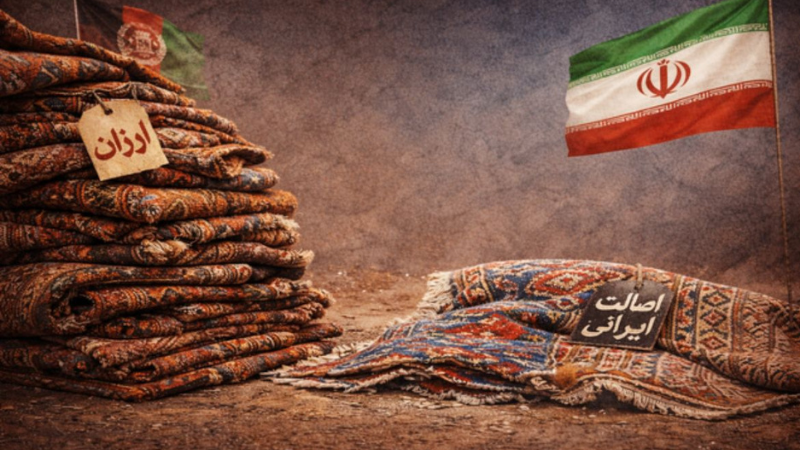
One of the most critical—and often overlooked—pressures comes from Afghan handwoven carpets. Produced with significantly lower labor costs, these carpets can enter the Iranian market at prices that Iranian weavers simply cannot match.
In itself, competition is not the problem. The issue arises when Afghan carpets—often entering through informal or semi-legal channels—are sold without clear origin labeling, and in some cases, presented to consumers as Iranian carpets.
This blurring of identity creates multiple layers of damage:
- Iranian weavers lose market share despite higher production standards and costs
- Consumers lose trust as quality expectations are not met
- The “Iranian carpet” brand is diluted in its own domestic market

Internal Weaknesses Deepen the Crisis
The pressure from Afghan carpets is compounded by internal challenges within Iran’s handwoven sector. To survive in a price-sensitive market, some producers have been forced to cut corners:
- Cheaper raw materials
- Reduced knot density
- Synthetic dyes instead of traditional natural dyes
As a result, low-quality Iranian handwoven carpets now exist alongside imports—sometimes performing worse in durability tests than Afghan counterparts. This further erodes consumer confidence and accelerates the shift away from authenticity.
Why Iranian Carpets Cannot Compete on Price
The structural reality is simple: Iranian handwoven carpets cannot win a price war.
Iranian labor costs are multiple times higher than Afghan weaving costs. At the same time, machine-made carpets—now including wool-look and high-density products—offer visually similar alternatives at a fraction of the price.
If Iranian handwoven carpets attempt to compete purely on cost, they lose the very qualities that once made them globally distinctive.
The Missing Shield: Transparency and Certification
A critical missing element in the Iranian market is a robust, enforceable certification system. Without transparent documentation covering origin, materials, dyes, knot density, and production time, consumers cannot distinguish:
- Iranian vs. Afghan
- Authentic vs. compromised quality
This lack of transparency allows mislabeling, weakens pricing integrity, and accelerates the race to the bottom.
A Strategic Crossroads
The current pressure from Afghan carpets is not merely a trade issue—it is a strategic warning.
Iran’s handwoven carpet sector can survive only if it reclaims differentiation, not through nationalism or nostalgia, but through:
- Clear origin labeling
- Quality-based segmentation
- Internationally credible certification
- Positioning handwoven carpets as cultural and artistic products—not mass-market floor coverings
Final Thought
Afghan carpets are not the enemy. They are efficient, affordable, and legitimate products within their own identity.
The real danger for persian hand made carpet lies in a market where identity is blurred, standards are weakened, and authenticity is sacrificed for short-term survival.
If Iranian handwoven carpets lose clarity in their own market, reclaiming their position on the global stage will become exponentially harder.
The pressure is already visible. The response must now be structural, not emotional.

